Stone-Coated Steel Roofing in Round Rock, TX
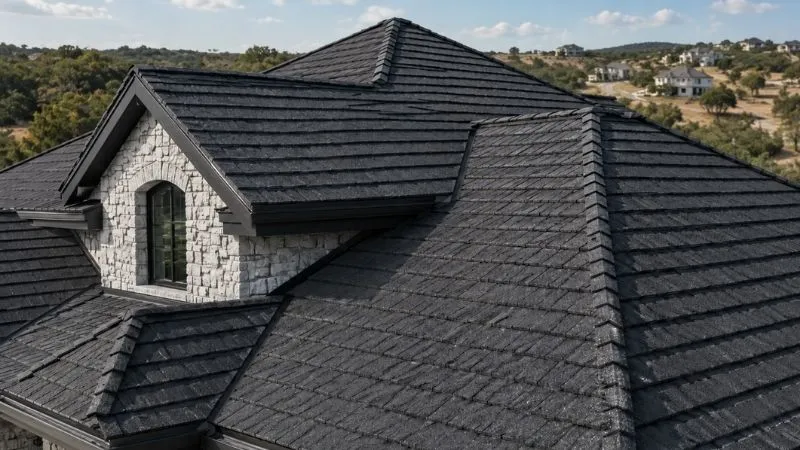
Stone-coated steel gives you the look of shingles, shake, or tile with the durability of metal. Steel panels are coated with stone granules, so the roof reads as traditional from the street while carrying a Class 4 hail rating and a lifespan near 50 years. It typically runs $12 to $18 per square foot installed — and it's the usual answer when an HOA won't allow standing seam.
What is stone-coated steel roofing?
Stone-coated steel starts as a steel panel — usually Galvalume, the same corrosion-resistant base used in standing seam. Crushed stone granules are bonded to the surface and sealed with an acrylic overglaze. The result looks like a shake, tile, or shingle roof from the ground, but it's steel underneath. Panels interlock and are fastened to the deck or to battens, depending on the system.
Why do Round Rock homeowners choose it?
Mostly for one of two reasons. The first is HOA rules. Round Rock is a town of master-planned neighborhoods — Teravista, Behrens Ranch, Forest Creek — and most of them have appearance standards written when asphalt shingles were the only thing anybody put on a house. Stone-coated steel usually clears those standards without an argument, because from the street it reads as a shake or tile roof. The second reason is budget: it delivers most of metal's durability at a price between asphalt and standing seam.
Can my HOA stop me from installing it?
Possibly not, and Texas law is on your side more than most people realize. Texas Property Code §202.011 says a property owners' association may not prohibit a homeowner otherwise allowed to install shingles from installing shingles designed to be wind and hail resistant — provided the product resembles what's already authorized in the subdivision, is more durable and of equal or better quality, and matches the surrounding aesthetics.
Stone-coated steel is about as good a fit for that language as a product can be: it is shingle- or tile-profile, it is impact-rated, and looking like the neighbours is the entire point of it. That is a genuinely stronger position than a standing seam application would be, since the statute is written around shingles.
Two honest caveats. The statute sets conditions, and whether your specific product meets them in your specific subdivision is a question for your HOA's documents and, if it gets contentious, a lawyer — not for a roofer. And we'd always rather you submit to your architectural review committee and get a yes than rely on a statute to win a fight. We can give you the product data sheets and impact ratings for the submission.
Texas Property Code § 202.011, added by Acts 2011, 82nd Leg., R.S., Ch. 939 (H.B. 362), effective 17 June 2011. This is general information, not legal advice.
You still get the things that make metal worth it here — a Class 4 impact rating against Central Texas hail, fire resistance, roughly 50 years of service life, and eligibility for the same insurance discounts many Texas carriers offer on impact-rated roofs.
What profiles and looks are available?
| Profile | What it looks like |
|---|---|
| Shake profile | Mimics split cedar shake with deep shadow lines. Popular on the older streets around Old Town and on craftsman homes. |
| Tile / barrel profile | The look of Spanish or concrete tile at a fraction of the weight. |
| Slate profile | Flat, dimensional lines that read like natural slate. |
| Shingle profile | The most familiar look — closest to an architectural asphalt shingle. |
Each profile comes in a range of blended colors, which helps it read as a natural material rather than a flat painted surface. We'll bring samples so you can hold them against your brick, stone, or stucco before deciding.
How much does stone-coated steel cost?
Expect roughly $12 to $18 per square foot installed in Central Texas — about $30,000 to $45,000 on a 2,500-square-foot home. That's meaningfully less than standing seam and more than asphalt, which is exactly where most homeowners expect it to land given the lifespan. See the full Round Rock cost guide.
Stone-coated steel vs. standing seam — which is right?
Both are excellent metal roofs. The decision usually comes down to appearance and budget:
- Choose stone-coated steel if your HOA restricts metal's appearance, you prefer a traditional shingle or tile look, or your budget sits below standing seam.
- Choose standing seam if you want maximum lifespan, a modern architectural look, no exposed fasteners anywhere, or plan to add solar panels. See standing seam.
Not sure? That's a normal place to be. A free inspection includes walking through both options against your actual roof and neighborhood.
Stone-coated steel FAQs
Will my HOA approve a stone-coated steel roof?
How much does stone-coated steel cost in Round Rock?
Is stone-coated steel as durable as standing seam?
Does the stone coating wear off?
Ready for a straight answer on your roof?
Call for a free inspection — we'll take a look, walk you through your options, and there's no pressure either way.
Call (737) 320-3400